
BARC talk by Daniel Stilck França
Monday, November 16, 2026, 14:01-15:00, Daniel Stilck França, Associate Professor at the University of Copenhagen, Denmark, will be giving a BARC talk on "Efficient Thermalization and Universal Quantum Computing with Quantum Gibbs Samplers".
Abstract:
Sampling from a Gibbs distribution π(x) ∝ e^{−βH(x)} by running a local Markov chain such as Glauber dynamics is a cornerstone of randomized algorithms and approximate counting, and the spectral gap of the chain is the standard tool for proving that it mixes rapidly. This talk concerns the quantum analogue of that picture. Here H is a local Hamiltonian (a sum of terms each acting on O(1) qubits, the quantum analogue of a local energy function), the target is the quantum Gibbs state ρ ∝ e^{−βH} (a matrix rather than a probability vector), and the algorithm is a quantum analogue of MCMC: a sequence of local updates whose fixed point is ρ. As in the classical setting, convergence is controlled by a spectral gap.
Our main result is that at sufficiently high temperature this gap is bounded below by a constant independent of the system size. This is the first result showing that a quantum analogue of MCMC provably converges at high temperature, and it yields an efficient algorithm for preparing Gibbs states on a quantum computer in this regime, a quantum counterpart of the classical fact that high temperature implies fast mixing. No prior knowledge of quantum Gibbs sampling will be assumed.
Joint work with Cambyse Rouzé and Álvaro M. Alhambra, accepted at STOC 2025.
 Bio:
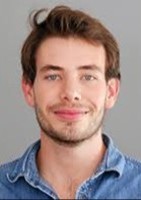
Daniel Stilck França is an Associate Professor in the Department of Mathematical Sciences at the University of Copenhagen, affiliated with the Quantum for Life centre. He obtained his doctorate at the Technical University of Munich in 2018 under the supervision of Michael M. Wolf. He was previously a postdoctoral researcher at QMATH and held an Inria Starting Faculty Position at École Normale Supérieure de Lyon. His research spans quantum algorithms, quantum learning, information theory, mathematical physics, and optimization. He holds an ERC Starting Grant for GIFNEQ, a project developing a Gibbs-state framework for near-term quantum computing.
Host:
Théo Fabris